
The Real Reason Your Ads Aren't Converting (Hint: It's Not the Ads)
Every week, someone asks some version of the same question. "Can we just run some ads and get more guests?" Sure. You can always buy traffic. The real question is what happens to it when it gets there.
Paid ads do not create momentum out of nothing. They connect to whatever system your business already has, and then they accelerate it. If that system is strong, ads bring more of what you want: leads, bookings, sales, calls, foot traffic. If that system is weak, ads bring more of what you do not want, faster and at your expense.
That is not a failure of the platform. That is the platform doing exactly what it was built to do.
Ads Are a Diagnostic Tool. Most People Treat Them Like a Growth Button.
Here is a reframe I come back to constantly.
Paid media is not just a traffic channel. It's pressure applied to your funnel. And pressure reveals things.
When a campaign underperforms, the instinct is to ask whether the creative is bad, whether the audience is wrong, whether the budget is too low. Those are fair questions. But they are often the last ones that should be asked.
The better questions are: Did the right people land on a page that made sense to them? Did the offer give them a reason to act? Did the page earn enough trust to move them forward? Did we track the action that actually matters to the business? And when a lead came in, did someone receive it well?
At Pollinate Marketing, that is how we approach every underperforming account. Not as an ads problem, but as a systems question. Anyone can run ads. Not everyone cares enough to connect the dots between the business, the campaign, and the outcome. That gap is exactly where we spend our time.
The Six Things Ads Usually Expose
What I see consistently when campaigns underperform is that it almost never starts with the ads themselves.
1. The offer is not clear enough.
People clicked. They did not convert. This gets blamed on targeting, on creative, on the algorithm.
But sometimes the ad did its job. It got attention, created curiosity, drove a click. And then the destination did not give the person a clear enough reason to take the next step.
If prospects bounce quickly, submit nothing, or ask questions that should have been answered on the page already, the campaign is not broken. The offer is.
2. The landing page drops the conversation.
The ad makes a promise. The landing page has to keep it.
When someone clicks on an ad for a specific thing and lands on a generic homepage, or a page that does not continue the same message, the momentum stops. The user does not feel confused. They just leave.
I see this constantly with service businesses that have longer buyer journeys. A commercial interiors firm, for example, is not selling a $12 product. The buyer is doing real due diligence. They want project scale, sector experience, proof of work, process. A contact form at the bottom of a thin page is not doing that work.
The ad can be excellent. If the page does not answer the trust questions the buyer is already carrying, conversion suffers, and the ads take the fall.
3. The tracking is not built for how the business actually works.
This one is sneaky, and It's probably the most common issue I run into.
A restaurant does not convert on a form fill. A local service business closes jobs on a phone call. A fitness studio gets members who walk in, try a class, and decide in person. None of those actions are automatically visible to an ad platform.
If your tracking only captures what is easy to track, you are not optimizing toward what matters. You are optimizing toward what is measurable. Those are not always the same thing.
Perfect attribution is genuinely rare. But building practical signal, phone call tracking, reservation link clicks, direction requests, offline conversion data, gives a campaign something real to learn from. Without it, everyone argues about whether the ads worked. With it, the conversation becomes useful.
4. The creative is too thin to sustain performance.
One ad carrying an account is not a win. It's a liability.
When frequency climbs and a single creative is doing all the work, the campaign is not healthy. It's fragile. The moment that asset tires, which it will, performance drops and everyone panics.
This is especially common in small-budget Meta accounts. There was not enough creative depth to test with, so the one thing that clicked kept running until it stopped. Then the account looks like it "stopped working."
It did not stop working. The brand ran out of things to say.
5. The follow-up is slow or missing.
A lead is not a result. A lead is a handoff.
Ads can generate the opportunity, but if the response is slow, the inbox is unmonitored, or there is no clear process for what happens after a form comes in, the campaign did its job and the business dropped it.
Speed-to-lead matters more than most businesses realize. An account generating leads and a sales process that is not following up on them quickly will always look like a campaign problem. It rarely is.
6. The budget is too small for the expectation.
A $400 monthly budget is a learning budget, not a scaling budget.
That is not a criticism. Learning is genuinely valuable. But a small budget needs the right job description. It can help you understand which messages get attention, which search terms signal real intent, where friction lives on the page, and whether demand exists to justify more investment.
What it cannot do is deliver volume, stability, and consistent ROI simultaneously. Setting that expectation clearly, at the start, is part of what honest strategy looks like.

A Quick Diagnostic: Before You Blame the Ads
When a campaign underperforms, we work through this before we touch anything in the account.
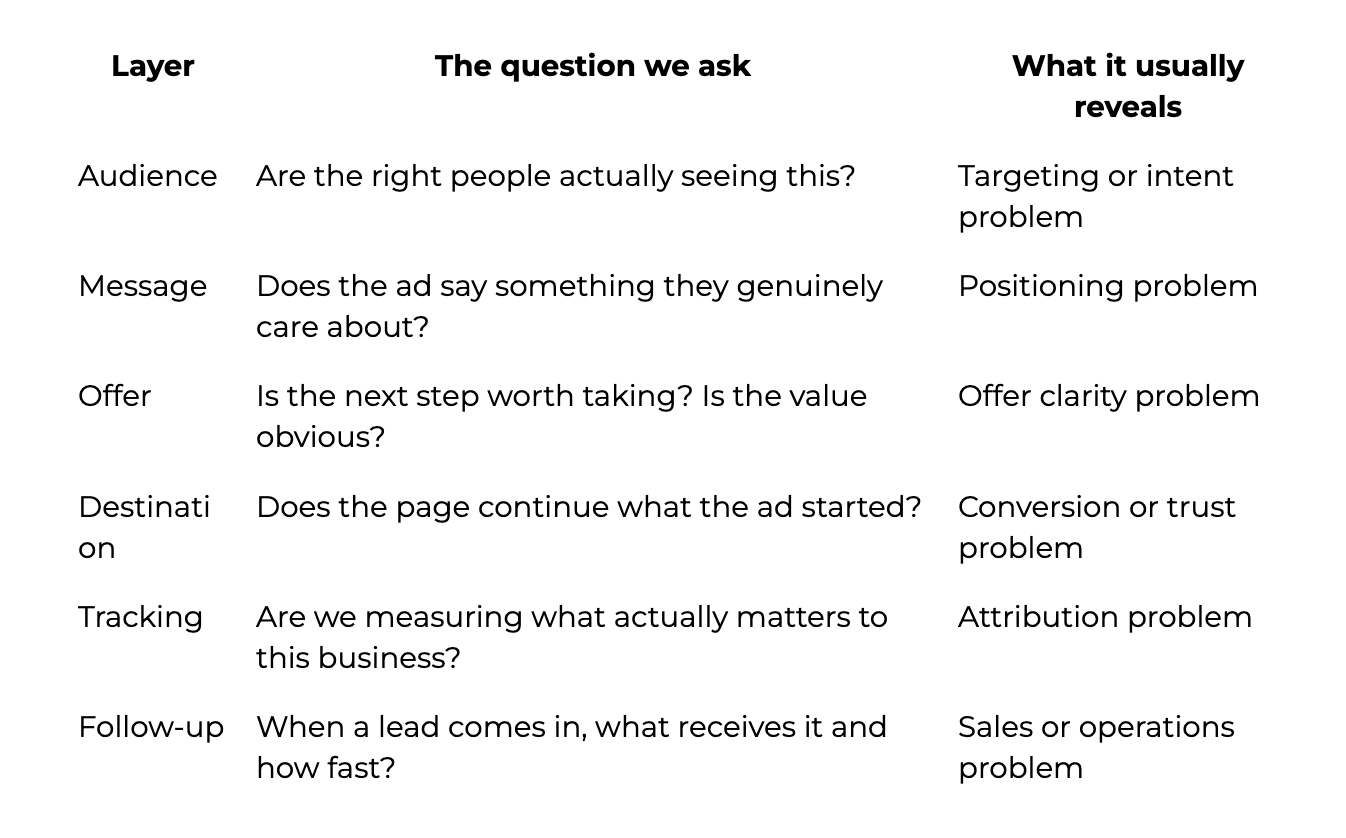
Most campaign problems live in one of those six rows. Very few of them live inside the ad platform itself.
What This Means If Your Ads Feel Like They Are Not Delivering
If you are working with an agency and it feels like the campaigns are not moving the needle, I would gently push back on one assumption: that the problem is the ads.
The harder question is whether the agency running them cares enough to look further. To ask what the campaign is revealing about the offer, the page, the tracking, the follow-up. To connect what is happening inside the platform to what is happening inside the business.
At Pollinate Marketing, that is the work we actually care about. Not just running ads, but reading what they are telling us, and using that to build something that works past the first 30 days.
Paid media is honest. It will show you what is working, what is not, and where the friction is. The businesses that get the most from it are the ones that treat the campaign as a feedback loop, not a vending machine.
If your campaigns feel stuck, the question worth sitting with is not "what is wrong with the ads?"
It's: what are the ads trying to tell you?

Ready to Build Content That Converts?
Creating content that stands out requires strategy, consistency, and deep understanding of your guests. At Pollinate Marketing, we help boutique hotels and restaurants build content strategies that feel unmistakably like them, and drive measurable bookings.
Schedule a Discovery Call or Sign Up for Our Newsletter
Related Topics: Hotel Google Ads strategy, boutique hotel paid advertising, hotel landing page optimization, hotel marketing attribution, why hotel ads don't convert, hotel direct booking campaigns, hospitality PPC strategy, hotel marketing funnel, restaurant paid advertising
